L’optique géométrique, essentiellement basée sur le concept de rayon lumineux, permet d’interpréter simplement la formation des images à l’aide de lentilles et/ou miroirs.
Cette théorie approximative ne rend pas compte de l’aspect ondulatoire de la lumière. Or, on sait depuis la théorie électromagnétique de Maxwell et de sa confirmation par Hertz, que la lumière est une onde électromagnétique.
Dès lors, certains phénomènes optiques comme les interférences lumineuses et la diffraction diffraction ne peuvent pas s’interpréter sans tenir compte de ces aspects ondulatoires.
Cette théorie approximative ne rend pas compte de l’aspect ondulatoire de la lumière. Or, on sait depuis la théorie électromagnétique de Maxwell et de sa confirmation par Hertz, que la lumière est une onde électromagnétique.
Dès lors, certains phénomènes optiques comme les interférences lumineuses et la diffraction diffraction ne peuvent pas s’interpréter sans tenir compte de ces aspects ondulatoires.

- énoncer les conditions d’obtention d’interférences lumineuses à l’aide de deux sources ponctuelles monochromatiques ;
- écrire, commenter et exploiter la formule de Fresnel ;
- Utiliser le contraste pour décrire une figure d’interférences ;
- mettre en œuvre un montage expérimental permettant d’étudier des interférences lumineuses à deux ondes
- mettre en évidence les cohérences spatiale et temporelle (perte de contraste, localisation)
3. Chemin optique et déphasage
On considère un rayon lumineux allant d'un d'un point `M` jusqu'en un point `N`
Par définition, le chemin optique `(MN)` parfois noté `L_(MN)` est : `L_(MN)=c*t_(MN)`
avec `c`, la célérité de la lumière dans le vide et `t_(MN)` le temps mis par la lumière pour aller de `M` à `N`
Par définition, le chemin optique `(MN)` parfois noté `L_(MN)` est : `L_(MN)=c*t_(MN)`
avec `c`, la célérité de la lumière dans le vide et `t_(MN)` le temps mis par la lumière pour aller de `M` à `N`

Dans un milieu homogène, transparent et isotrope d'indice `n` , le chemin optique est `(MN)=L_(MN)=n*MN`
`Deltaphi_(MN)=(2pi)/lamda*L_(MN)`
2. Interférence entre deux ondes
Lorsque l’on superpose deux faisceaux monochromatiques, l’intensité qui en résulte varie entre un maximum qui dépasse la somme des intensités et un minimum qui peut être nul. Ce phénomène est appelé interférence et concerne tout phénomène ondulatoire.
En optique, son observation est rendue difficile car les sources réelles ne sont jamais absolument monochromatiques: elles sont le siège de fluctuations aléatoires de phase et d’amplitude qui brouillent les interférences.
En optique, son observation est rendue difficile car les sources réelles ne sont jamais absolument monochromatiques: elles sont le siège de fluctuations aléatoires de phase et d’amplitude qui brouillent les interférences.

2.1. Superposition de deux ondes non synchrones
Lorsque deux ondes non synchrones se superposent, l’intensité qui en résulte est simplement la somme des intensités de chacunes des ondes. `I=I_1+I_2`2.2. Superposition de deux ondes synchrones
L’intensité résultant de la superposition de deux ondes n’est pas égale à la somme des intensités. On dit qu’il y a un phénomène d’interférence ou que les ondes interfèrent.
L'onde issue de la source `S_1` arrive en `M` avec un retard de phase `phi_1=(2pi)/lambdaL_(S_1M)+varphi_1`
de même pour l'onde issue de `S_2` : `phi_2=(2pi)/lambdaL_(S_2M)+varphi_2` de sorte que : `Deltaphi=(2pi)/lambdadelta+Deltavarphi`
avec `delta=L_(S_2M)-L_(S_1M)`, la différence de chemin optique (appelé aussi différence de marche).Pour le déphasage `Deltavarphi=varphi_2-varphi_2`, on distingue deux cas :
à retenir
Différence de phase : Le cas le plus simple correspond à deux sources qui émettent en phase : `varphi_1=varphi_2` : dans ce cas la différence de phase est `Deltaphi=(2pidelta)/lambda`
Formule de Fresnel : l'intensité résultante de la superposition de deux ondes synchrones, cohérentes s'écrit : `I=I_1+I_2+2sqrt(I_1I_2)cosDeltaphi`
L'intensité résultante n'est pas égale à la somme des intensités, les ondes interfèrent, le terme `2sqrt(I_1I_2)cosDeltaphi` représente le terme d'interférence.
Conditions d'obtention d'interférences : pour observer des interférences stables, il faut que les deux ondes soient cohérentes c'est à dire :
de même pour l'onde issue de `S_2` : `phi_2=(2pi)/lambdaL_(S_2M)+varphi_2` de sorte que : `Deltaphi=(2pi)/lambdadelta+Deltavarphi`
avec `delta=L_(S_2M)-L_(S_1M)`, la différence de chemin optique (appelé aussi différence de marche).
- Si `Deltavarphi` varie de façon aléatoire, alors `"<"cosDeltavarphi">"=0`.
dans ce cas il n'y a pas d'interférence. On dit que les sources sont incohérentes - Si `varphi_1` et `varphi_2` varient de façon aléatoire mais pas `Deltavarphi` qui reste constant
les sources sont dites cohérentes et il y'a des interférences.
Différence de phase : Le cas le plus simple correspond à deux sources qui émettent en phase : `varphi_1=varphi_2` : dans ce cas la différence de phase est `Deltaphi=(2pidelta)/lambda`
Formule de Fresnel : l'intensité résultante de la superposition de deux ondes synchrones, cohérentes s'écrit : `I=I_1+I_2+2sqrt(I_1I_2)cosDeltaphi`
L'intensité résultante n'est pas égale à la somme des intensités, les ondes interfèrent, le terme `2sqrt(I_1I_2)cosDeltaphi` représente le terme d'interférence.
Conditions d'obtention d'interférences : pour observer des interférences stables, il faut que les deux ondes soient cohérentes c'est à dire :
- être synchrones (même fréquence ou même pulsation)
- avoir déphasage `Deltavarphi` constant au cours du temps
2.3. Superposition de deux ondes synchrones de même intensité
`I=2I_0(1+cosDeltaphi)`
Montrer que le déphasage entre deux points `M` et `N` vibrant en phase est `Delta(phi_(MN))=phi(M)-phi(N)=(2pi)/lamda*L_(MN)` ⭐⭐
`I=2I_0(1+cosDeltaphi)`
Il existe des endroits où l’intensité est maximale qui forment alors des franges brillantes.
Ces endroits correspondent à la superposition d’ondes en phase (`Deltaphi=2kpi` avec `kinZZ`).
Ce qui quadruple l’intensité du rayonnement (`Deltaphi=2kpiRightarrowcosDeltaphi=1RightarrowI=4I_0`). Dans ce cas les interférences sont constructives.
Ce qui quadruple l’intensité du rayonnement (`Deltaphi=2kpiRightarrowcosDeltaphi=1RightarrowI=4I_0`). Dans ce cas les interférences sont constructives.
De même, il existe des endroits où l’intensité est nulle qui forment alors des franges sombres et qui correspondent à la superposition d’ondes en opposition de phase `Deltaphi=(2k+1)pi` avec `kinZZ`.
Ce qui annule l’intensité du rayonnement (`Deltaphi=(2k+1)piRightarrowcosDeltaphi=-1RightarrowI=0`). Dans ce cas les interférences sont destructives.
Deux ondes interfèrent de façon constructive quand leur déphasage est un multiple de `2pi`, c’est-à-dire quand la différence de chemin optique est un multiple de longueur d’onde.
`Deltaphi=2kpi`
ou `delta=klambda` avec `kinZZ`
`Deltaphi=(2k+1)pi`
ou `delta=(2k+1)lambda/2` avec `kinZZ`
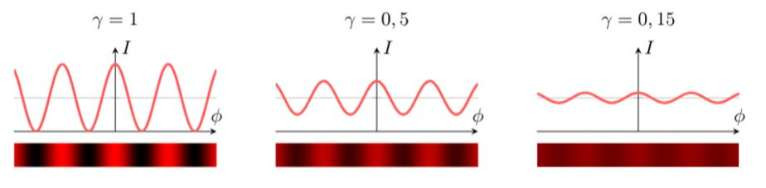
3. Franges d'interférence et facteur de visibilité
Quand les ondes qui interfèrent ne présentent pas la même intensité, il n’est plus possible d’obtenir `I = 0`
En effet, l’intensité vaut au minimum `I_min =I_1+I_2-2sqrt(I_1I_2)` et au maximum `I_max = I_1+I_2+2sqrt(I_1I_2)`
En effet, l’intensité vaut au minimum `I_min =I_1+I_2-2sqrt(I_1I_2)` et au maximum `I_max = I_1+I_2+2sqrt(I_1I_2)`
`gamma=(I_max-I_min)/(I_max+I_min)`